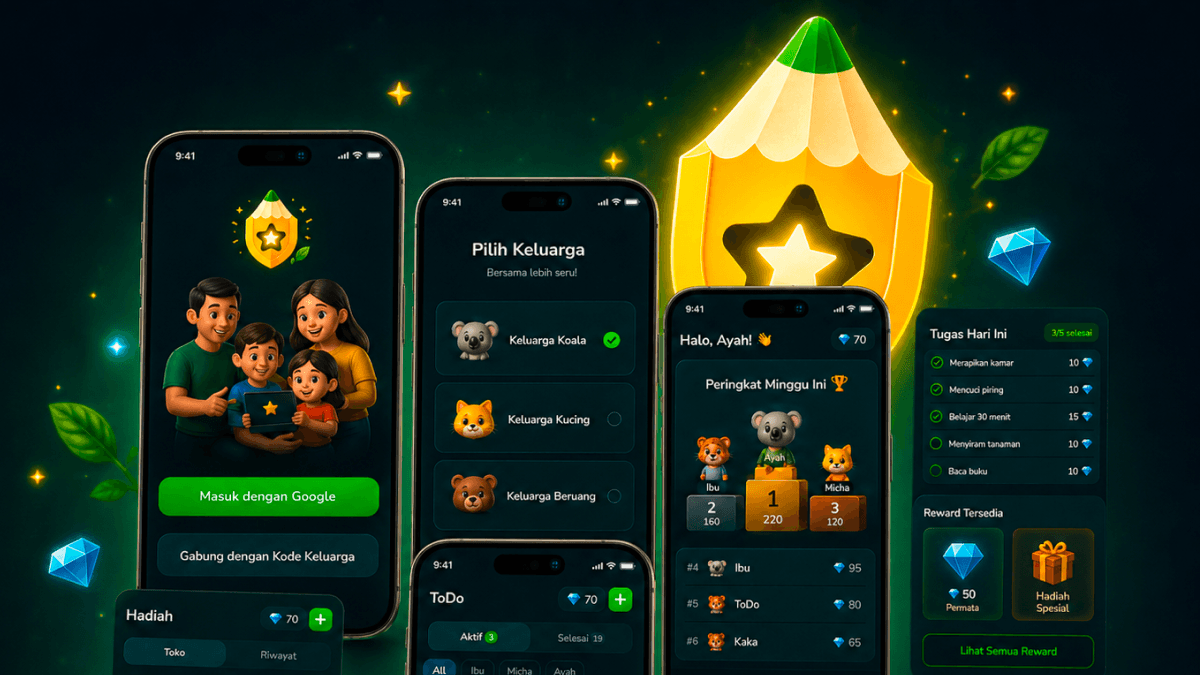
Gamified Habit Platform for Children — Asah
Asah is a gamified habit and task platform designed for children and families. The product helps parents turn daily responsibilities, household tasks, and learning routines into small missions that children can complete, verify, and redeem for rewards.
Role & services
Product Design, AI Engineer
Timeline
1
Industry / context
Educations
Problem We Were Solving
Children often need repeated guidance to build routines, complete responsibilities, and stay motivated. At the same time, parents need a system that helps them assign tasks, track progress, and reward positive behavior without turning every interaction into a reminder or conflict.
The key problem was not simply “how to make a task app for kids,” but how to make routines feel motivating, visible, and fair inside a family context.
Pain points and constraints :
Children may not feel ownership when tasks are only given as instructions.
Parents need a lightweight way to create, verify, and reward tasks.
Rewards need to feel meaningful, but still controlled by parents.
The experience must be simple enough for young children to understand.
The system needs to support motivation without encouraging unhealthy competition.
Goals and Success Metrics
User Goals
Help children understand what tasks they can do next.
Make task completion feel rewarding and visible.
Give children a sense of progress through diamonds, XP, levels, and leaderboard.
Help parents manage tasks, todo, and rewards without too much manual effort.
Create a shared family system that encourages positive routines.
Business Goals
Build a clear MVP for a family-based gamified habit platform.
Validate whether gamification can make daily routines more engaging for children.
Create a reusable product foundation for future family productivity features.
Explore a product direction that combines habit-building, parenting support, and child-friendly motivation.
Potential success metrics:
Increase weekly completed tasks by
[target % or number]Increase repeat weekly usage by
[target % or number]Track number of tasks created per family per week
Track number of tasks completed and verified per child
Track reward redemption frequency
Measure parent satisfaction through qualitative feedback
Measure whether children understand the task and reward flow without repeated explanation
Research Approach and Baseline
The initial research was based on understanding existing habit-building and gamification products, especially platforms like Habitica, and identifying what would need to change for a younger audience.
Key areas explored:
How gamified productivity products structure tasks, rewards, and progression
How children respond to simple visual reward systems such as points, badges, levels, and rankings
How parents manage responsibility, approval, and fairness inside the family
How to simplify task management so it does not feel like an adult productivity tool
How to balance autonomy for children with control and verification for parents
Early insights:
Habitica-style gamification is powerful, but its interface and mental model are too complex for young children.
Children need immediate, visible feedback after completing a task.
Parents need approval controls because rewards should not be given without context.
A family leaderboard can create motivation, but it must be framed as weekly encouragement rather than permanent ranking.
A diamond-based reward system is easier for children to understand than abstract points.