Short-Form Intelligence Experience — V+ Short
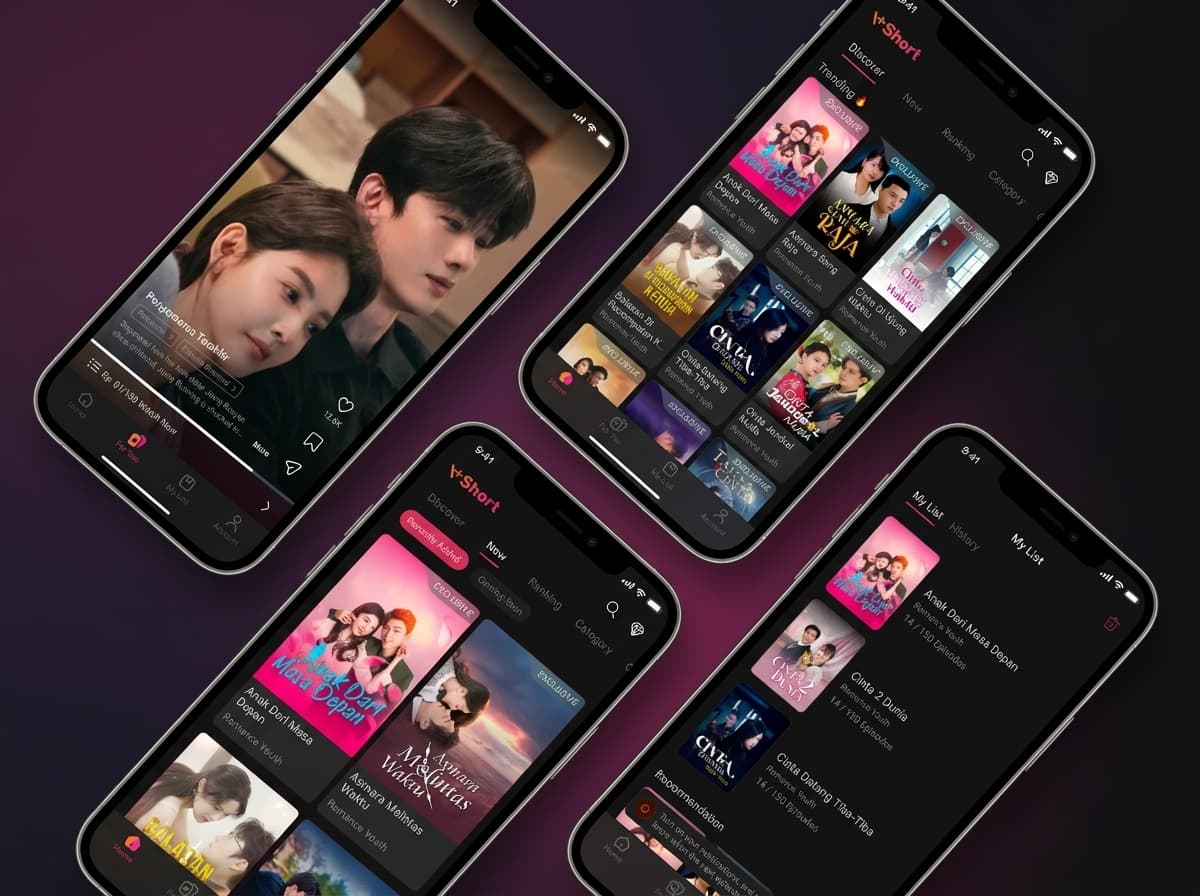
This project defined the full AI recommendation experience for a brand-new vertical OTT platform built by MNC Group, developed under the Vision+ product umbrella. Is a mobile-first, short-form video streaming app targeting global audiences with AI-localized vertical drama and entertainment content. It was designed as a distinct product from Vision+, with its own developer identity and app store presence, competing directly with players like DramaBox, YouTube Shorts, and TikTok Series. My work focused specifically on how AI-powered recommendations (via Recombee) should be architected, designed, and experienced across the app's core surfaces.
Role & services
Product Design, UX Strategy, AI Strategiest
Timeline
3 Months
Industry / context
Entertainment
Key Responsibility
Scope | End-to-end, from recommendation strategy and UX research to flow design, scenario definition, cross-functional alignment, and delivery. |
What I owned | Defining which recommendation models map to which surfaces, designing the user journeys around those models, specifying behavior for cold-start and returning users, and documenting the logic for engineering and data teams. |
Collaborators | Product managers, data/ML engineers, backend and frontend engineers, CMS team, content and business stakeholders |
Problem We Were Solving
This was a greenfield product. The core challenge was not fixing a broken recommendation experience. It was designing the right one from scratch, before any user data existed.
The platform's core differentiation relied on personalization: without strong AI recommendations baked into the UX from day one, it would feel like any generic content catalog.
Short-form vertical content is high-volume and low-context per title, meaning users decide in seconds whether to keep watching or bounce, making recommendation quality critical to engagement.
MNC's existing content library and production pipeline needed to be transformed into a short-form, mobile-first discovery experience that could serve both cold-start users (no history) and returning users with growing behavioral signals.
Business stakeholders needed a recommendation framework that could also respect editorial control, boosting curated or strategic titles without abandoning algorithmic relevance.
Goals and Success Metrics
User Goals | Business Goals |
|
|
Research Approach and Baseline
Since this was a new product, I approached discovery from two angles: understanding the market and user landscape from the outside, and building the internal recommendation logic framework from first principles.
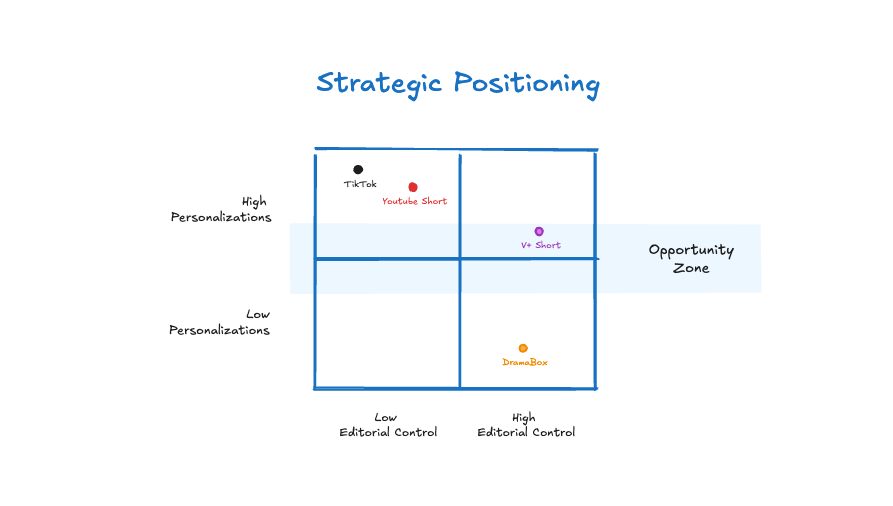
Market and competitor analysis: Benchmarked DramaBox, YouTube Shorts, and TikTok Series to understand how recommendation-led short-form OTT platforms present and sequence content and where MNC could differentiate.
Audience definition: Studied three primary audience segments. Gen Z viewers (18–25), Working Adults (26–40), and older demographics, to understand distinct discovery behaviors, content preferences, and session patterns.
Recommendation system audit: Reviewed Recombee's modular recommendation capabilities and mapped them against the platform's content types, user event signals, and business constraints.
Signal mapping: Identified the four core user behavior signals the recommendation engine would rely on: View, Watch Duration, Likes, and Watch History.
Cold-start constraint: A critical insight was that with zero user data at launch, the system needed a structured fallback strategy, defaulting to popular and exploration-based content until behavioral signals accumulated (10+ and 50+ interaction thresholds)
Ideation & Solution Exploration
The core design challenge was translating a flexible recommendation engine into a structured, coherent user experience across five distinct surface types, each serving a different user intent.
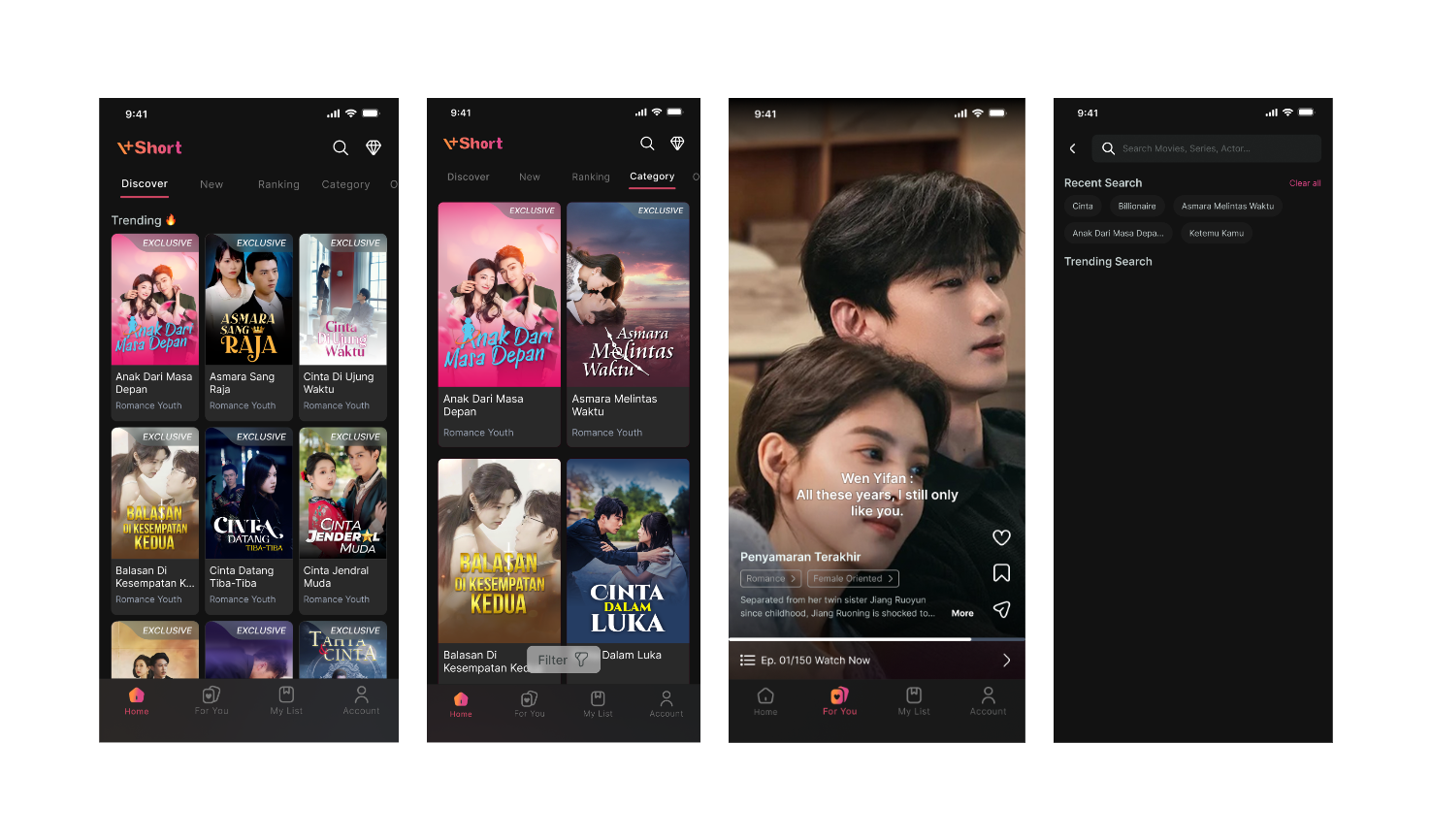
I mapped each surface to the right Recombee model and logic, explicitly designing for both cold-start and personalized states:
Surface | Model | Rationale |
|---|---|---|
Discover / Home | Trending/Popular + Hard Boost | Business editorial control + broad appeal for all users |
You Might Like | Personalized (exclude trending) | Avoid content duplication; serve taste-based discovery |
For You Page | Swiping feed (personalized) | Real-time behavior-adaptive; TikTok-style sequential consumption |
Category Pages | Personalized + Velocity/Freshness | Group content by shared attributes, reward new and rising content |
Search | Semantic + Personalized | Go beyond keyword matching to intent-based results |
Key design decision and Trade-Offfs :
Trending vs. Personalized on home: Business stakeholders initially wanted a fully personalized home, but we recommended a Trending/Popular model with hard-boosted curated titles, because a cold-start platform cannot earn personalization trust on day one, and popularity-based signals drive early engagement while behavioral data accumulates.
Hard Boost logic: Editorial teams can promote specific titles by inputting them into the "Boost Specific Title" CMS field. All boosted titles appear sequentially first, with remaining slots filled by AI. This gives business control without sacrificing recommendation quality.
Avoiding duplicity: "You Might Like" explicitly excludes trending content to prevent users from seeing the same title across multiple rails in the same session.
For You Page behavior: Designed as a swipe-feed that adapts in real time to engagement signals, the most aggressive personalization surface on the platform, deliberately separated from other recommendation rails to avoid overlap.
Design Outputs
Other Outputs
A significant portion of my effort was translating business and data complexity into clear design specs and alignment artifacts.
Recommendation scenario matrix: A structured mapping of each app surface to its Recombee model, definition, user signal requirements, cold-start fallback, and business logic (e.g., hard boost behavior).
PRD collaboration: Co-authored the product requirements for recommendation behavior, audience segmentation, user events to be tracked, and success metrics alongside the product team.
CMS design for editorial control: Designed the backend CMS experience for content managers to configure hard boosts, curated titles, and recommendation weights, enabling business teams to act without engineering support.
Cross-functional working sessions: Facilitated alignment sessions between product, data/ML, and engineering around event schema design (View, Watch Duration, Likes, Watch History), metadata structure, and recommendation API integration.
Testing & Validation
Since this is a new product, validation is primarily designed for post-launch measurement rather than pre-existing baselines.
Usability validation approach: Test the core recommendation surfaces (Discover, For You Page, You Might Like) with representative users from each audience segment to evaluate perceived relevance, discoverability, and navigation clarity.
Cold-start experience testing: Specific scenarios for new users with zero history — validating that the popular/exploration fallback feels engaging, not generic.
Editorial control QA: Verify that hard-boosted titles appear sequentially first and that AI fills remaining slots correctly across all surface types.
Post-launch measurement plan: Monitor CTR per rail, playbacks per session, swipe-through rate on For You Page, and return session rate segmented by user interaction tier (0–10, 10–50, 50+ interactions).
Final Results & Impact
This project is in the build and pre-launch phase (as of April 2026). Results will be tracked post-launch.
Strategic impact: Delivered a complete, production-ready recommendation architecture across five distinct surfaces. Replacing what could have been a generic content grid with a structured AI-led discovery system from day one.
Editorial and algorithmic balance: The Hard Boost + AI hybrid model gave business stakeholders meaningful control without sacrificing recommendation quality, a key tension resolved through design, not engineering.
Operational impact: The CMS design and scenario documentation enabled content and editorial teams to configure recommendations without engineering dependency.
Platform differentiation: Recommendation logic is now a core structural layer of the product, not an add-on feature. Directly supporting the platform's positioning against DramaBox and TikTok Series.
Reflection & Learnings
Cold Start is the Default State | Designing recommendation UX for a cold-start product forces rigor around fallback states. Most teams treat cold-start as an edge case. On a new platform, it is the default state and designing for it explicitly from the beginning shaped every surface decision. |
UX is the ML Translator | Translating a flexible ML system (Recombee) into clear, bounded UX scenarios requires product thinking, not just interaction design. The scenario matrix was as important as any wireframe. |
Resolve Tension in Design, Not Engineering | The Hard Boost logic was a real tension point between editorial and data teams. Resolving it in design before it became an engineering debate, will saved time and prevented scope creep during delivery. |
Alignment Artifacts are Design Work | Working across a PRD, a recommendation logic document, and Figma simultaneously reinforced how critical tight alignment artifacts are when a product has this much cross-functional complexity. |